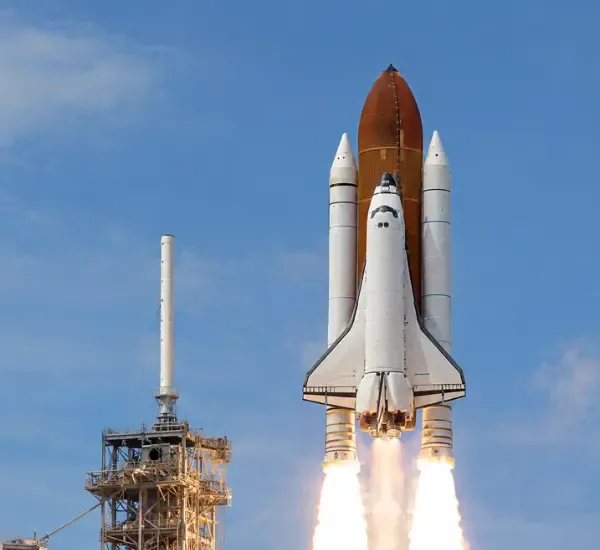
Rockets are one of the most remarkable achievements in aerospace engineering.
They allow humans and spacecraft to travel beyond Earth's atmosphere, launch satellites into orbit, explore other planets, and conduct scientific research in space.
But what makes a rocket move?
Unlike an aircraft, a rocket does not need surrounding air to generate thrust. Instead, it carries everything it needs to produce thrust, including both propellant and oxidizer.
So, how does a rocket actually work?
What Is a Rocket?
A rocket is a vehicle or propulsion system that generates thrust by expelling high-speed gases in one direction, producing a reaction force that moves the rocket in the opposite direction.
This principle comes from Newton's Third Law of Motion:
For every action, there is an equal and opposite reaction.
A rocket engine burns propellant inside a combustion chamber. The resulting high-pressure, high-temperature gases are accelerated through a nozzle and expelled at very high velocity.
The resulting reaction force produces thrust.
Because rockets carry their own oxidizer, they can operate in the atmosphere and in the vacuum of space.
How Does a Rocket Work?
The basic operation of a rocket can be simplified into four main steps:
1. Propellant is stored
Fuel and oxidizer are stored in tanks or contained within the solid propellant.
2. Propellants enter the combustion chamber
In a liquid rocket engine, pumps or pressurization systems deliver the propellants to the combustion chamber.
3. Combustion produces high-pressure gas
The fuel and oxidizer react, releasing a large amount of energy and producing extremely hot gases.
4. The gases are expelled through a nozzle
The nozzle accelerates the gases to very high velocity, generating thrust.
This process happens continuously while the engine is operating.
What Produces Rocket Thrust?
The fundamental relationship can be expressed through the rocket thrust equation:
F ≈ ṁVe + (Pe − Pa)Ae
where:
- F = rocket thrust
- ṁ = mass flow rate of exhaust
- Ve = exhaust velocity
- Pe = exhaust pressure
- Pa = ambient pressure
- Ae = nozzle exit area
The equation shows that rocket thrust depends heavily on the amount of propellant expelled and the velocity of the exhaust gases.
The higher the exhaust velocity, the greater the potential thrust and propulsion efficiency.
What Are the Main Parts of a Rocket?
Although rockets vary significantly in design, a typical launch vehicle may contain several major systems.
1. Propellant Tanks
Liquid rockets generally contain separate tanks for fuel and oxidizer.
The tanks must be strong enough to withstand internal pressure while remaining as lightweight as possible.
This creates an important aerospace engineering challenge:
How can engineers achieve sufficient structural strength without adding unnecessary mass?
2. Rocket Engine
The engine is the primary propulsion system.
It contains components such as:
• Combustion chamber
• Injectors
• Turbopumps or pressurization systems
• Valves
• Cooling systems
• Nozzle
The engine must operate under extremely high temperatures and pressures.
3. Combustion Chamber
The combustion chamber is where the fuel and oxidizer react.
The resulting combustion gases can reach extremely high temperatures.
The chamber therefore requires carefully engineered materials and cooling systems to prevent structural failure.
4. Nozzle
The nozzle converts thermal and pressure energy into high-velocity exhaust.
Many rocket engines use a converging-diverging nozzle, also known as a De Laval nozzle.
Gas accelerates through the converging section, reaches approximately sonic velocity at the throat, and can then accelerate to supersonic velocity through the diverging section.
The nozzle is therefore one of the most important components for converting combustion energy into useful thrust.
5. Guidance and Control System
A rocket must do more than simply move upward.
It must follow a carefully calculated trajectory.
Guidance systems determine where the rocket needs to go, while control systems adjust its motion.
Depending on the vehicle, control can involve:
• Engine gimbaling
• Thrust vector control
• Reaction control systems
• Aerodynamic control surfaces
These systems allow the rocket to maintain its desired orientation and trajectory.
What Fuel Do Rockets Use?
Different rockets use different propellants.
Liquid rocket engines may use combinations such as:
• Liquid hydrogen and liquid oxygen
• Kerosene-based fuels and liquid oxygen
• Methane and liquid oxygen
Solid rocket motors use a solid propellant containing both fuel and oxidizing components.
The choice of propellant depends on factors such as:
- Energy performance
- Storage requirements
- Temperature
- Engine design
- Mission requirements
- Reliability
- Cost
There is no single propellant that is ideal for every rocket.
What Is a Rocket Stage?
Large launch vehicles are often divided into multiple stages.
Each stage contains its own propulsion system and propellant.
Once a stage has consumed most of its propellant, it can be separated from the vehicle.
This reduces the mass that the remaining stages must accelerate.
For example, a launch vehicle may have:
First stage → Second stage → Upper stage → Payload
Staging is one of the key concepts that makes reaching orbit practical.
How Does a Rocket Get Into Orbit?
Getting into space is not simply about going upward.
To achieve orbit around Earth, a spacecraft needs enormous horizontal velocity.
Near low Earth orbit, the required orbital velocity is roughly 7.8 km/s, although the actual launch velocity required is higher because of atmospheric drag, gravity losses, and other factors.
This is why launch trajectories gradually transition from primarily vertical motion to a trajectory with a significant horizontal component.
The rocket must continuously increase its velocity while managing:
• Gravity
• Atmospheric drag
• Structural loads
• Aerodynamic forces
• Propellant consumption
• Thermal conditions
Why Doesn't a Rocket Need Air to Push Against?
One of the most common misconceptions about rockets is that they need air to push against.
They don't.
A rocket generates thrust by accelerating its exhaust gases.
The rocket and exhaust system exchange momentum. This allows the rocket to accelerate even in the vacuum of space.
This is fundamentally different from the way a conventional aircraft engine interacts with atmospheric air.
How Are Rockets Controlled?
A rocket must maintain its orientation throughout flight.
One common method is thrust vector control.
The engine can be rotated slightly so that the direction of thrust changes.
Even a relatively small change in thrust direction can produce a significant change in the rocket's attitude and trajectory.
Modern launch vehicles also use sophisticated onboard computers, sensors, navigation systems, and guidance algorithms to continuously control the vehicle.
The Engineering Behind Rockets
Rocket design combines several engineering disciplines.
Aerospace Engineering
Aerospace engineers design the overall vehicle, propulsion systems, aerodynamics, flight systems, and mission architecture.
Mechanical Engineering
Mechanical engineering is involved in engines, turbopumps, valves, mechanisms, thermal systems, and structural components.
Structural Engineering
Rocket structures must withstand enormous loads while remaining extremely lightweight.
Materials Engineering
Materials must survive high temperatures, pressure, vibration, acceleration, and extreme environmental conditions.
Thermodynamics and Fluid Mechanics
These disciplines are fundamental to combustion, gas expansion, heat transfer, and nozzle flow.
Mathematics and Physics
Rocket performance depends heavily on mechanics, differential equations, thermodynamics, fluid dynamics, and numerical analysis.
Rockets Are a Mass-Optimization Problem
One of the most important challenges in rocket engineering is mass.
Every kilogram added to a rocket requires additional energy and propellant to accelerate it.
This creates a continuous engineering trade-off between:
Strength ↔ Weight ↔ Performance ↔ Cost ↔ Reliability
Engineers therefore use advanced materials, structural optimization, computational analysis, and careful design to reduce unnecessary mass while maintaining adequate safety margins.
Conclusion
A rocket is much more than a powerful engine attached to a vehicle.
It is an integrated engineering system involving propulsion, structures, aerodynamics, thermodynamics, fluid mechanics, materials, control systems, mathematics, and physics.
At its most fundamental level, a rocket works by accelerating mass in one direction and generating an opposing reaction force that accelerates the vehicle.
But turning that basic physical principle into a vehicle capable of reaching orbit requires some of the most demanding engineering ever developed.
From the combustion chamber and nozzle to the guidance system and structural design, every component must work together with extreme precision.
That is what makes rocket engineering one of the most fascinating fields in engineering.
Posted in:Education